
On this page
What decision does a Dubai property investment guide support?
It supports a sequence, not a recommendation: define the objective, confirm the buyer can hold the intended right in the location, choose a purchase route, verify the asset and transaction, model cash and operations, and test the exit. A property should reach a shortlist only when every stage is evidenced or explicitly unresolved.
A property investment brief is a written statement of the buyer’s objective, available cash, acceptable time horizon, income need, operating involvement, risk limits and exit conditions. It prevents the project or sales narrative from defining the decision after the search begins.
The UAE Government’s foreign-buyer overview says foreign ownership in Dubai is permitted in designated freehold areas and that DLD issues title deeds. That establishes a legal starting point, not suitability for a particular buyer, entity or plot. The broader buyer hub explains the purchase surface; this pillar governs the investment file behind it.
The city-level case sits in its own document. Why invest in Dubai property sets out what the Dubai 2040 Urban Master Plan, published Dubai Land Department transaction data and approved transport projects establish about the environment an asset sits in, and what they do not establish about a single unit.
How should the investor brief be written?
Write testable constraints before viewing inventory:
- intended use: own occupation, annual rental, regulated holiday-home operation or future use;
- asset state: completed, tenanted, vacant or off-plan;
- maximum total acquisition cash and ongoing reserve;
- required evidence before reservation, contract and transfer;
- ability to manage locally or appoint accountable providers;
- circumstances that would trigger a sale, hold or refusal to proceed.
An investment objective is a measurable use for the property and capital, not a phrase such as “best return.” It should state what the asset must do, over what decision period, under which constraints, and what outcome would make it unsuitable.
Do not treat a residence outcome as certain in the brief. Property-linked residence criteria form a separate authority decision and should remain a conditional scenario.

Which acquisition route fits the brief?
Asset state, seller type, registration path, payment structure and completion dependency together decide the acquisition route used to obtain the property right. Ready resale, developer-completed inventory and off-plan purchase can lead to different evidence, timing and remedies.
| Route | Evidence available before commitment | Main dependency | Buyer question |
|---|---|---|---|
| Ready resale | Existing title, property status, physical inspection and contract file | Seller authority, restrictions, condition and transfer sequence | Does the present asset support the brief? |
| Completed developer inventory | Completed unit and developer transaction documents | Title or registration status, handover and defect responsibility | Is completion evidence sufficient? |
| Off-plan | Project, developer, escrow, provisional registration and contract records | Construction, payment milestones, registration and assignment conditions | Can the buyer accept delivery and exit uncertainty? |
| Best for | Choose only after the brief and evidence threshold are defined | Do not select by payment headline alone | Record why the route fits |
Use the separate due-diligence pillar for the full entity, project, title, contract and condition file. DLD’s sale-registration service confirms that completed-property registration is a formal process involving specified identity and transaction documents; a reservation does not replace it.

How should total ownership be modelled?
Acquisition cash, recurring property operations, financing where applicable, contingency reserves and exit dependencies belong on one timeline. That total ownership model is not a comparison between a headline purchase price and a later net operating result built from different assumptions.
Build the model in five layers:
- Acquisition: price or contract value, verified transaction charges and adviser costs.
- Funding: cash schedule, regulated bank conditions or developer-plan obligations.
- Holding: service charges, maintenance, insurance, vacancy and management responsibilities.
- Decision outcomes: own use, supported rent scenarios and compliance work.
- Exit: transfer eligibility, mortgage release, off-plan assignment conditions, documents and liquidity scenarios.
The financing pillar compares cash, bank and developer-plan structures without treating any as available by default. The exit and resale pillar then tests whether the acquisition remains manageable when the selling environment is weaker than expected.
How should the final decision file be governed?
Give every consequential statement a source, access date, owner and status. Separate fact, contract term, assumption and unresolved question. DLD’s service directory exposes official checks for property status, title deeds, licensed developers, brokers, projects and service charges; use the relevant record rather than a screenshot forwarded by a salesperson.
Set decision gates at reservation, contract, payment, transfer or provisional registration, handover and operation. A gate passes only when the named evidence exists and the responsible specialist has reviewed issues within their field.
What are the limitations of this investment framework?
This guide sequences the decision rather than recommending a project or predicting a return; it does not publish current prices or yields, and it is not legal, tax, mortgage, valuation or investment advice. It also does not decide a residence outcome: property-linked residence criteria are a separate authority decision, and any resulting visa eligibility stays a conditional scenario in the brief rather than an assumption the buyer can carry forward.
The acquisition route, total ownership model and exit conditions set out here depend on the specific project, developer and transaction, and are tested in the linked due-diligence, financing and exit-planning pillars rather than in this guide. A route from the comparison table above is not selected by its payment headline: it is fit for the brief only once that route's own evidence threshold has been met for the specific transaction, which this guide does not verify on the buyer's behalf.
Sources and verification
- Expatriates buying a property in the UAEThe Official Platform of the UAE GovernmentAccessed
- Property Sale RegistrationDubai Land DepartmentAccessed
- All ServicesDubai Land DepartmentAccessed
Frequently asked questions
Is Dubai property suitable for every international investor?
No. Suitability depends on ownership eligibility, objectives, cash, time horizon, operating capacity, concentration, currency exposure and a workable exit plan.
Should an investor choose ready or off-plan property first?
Define the objective and constraints first. The acquisition route should follow from the required timing, registration evidence, condition certainty, cash schedule and risk tolerance.
Does this guide provide current prices or rental yields?
No. Current comparisons require an approved data method and dated inputs. This guide explains the decision structure and routes readers to transparent data surfaces.
When are legal, tax or finance specialists needed?
Use specialists before relying on contract interpretation, ownership structure, cross-border tax treatment, credit availability, dispute remedies or any other consequential conclusion.
Related reading

Guides
Why Invest in Dubai Property? The 2040 Plan Evidence
What the Dubai 2040 Urban Master Plan, current Dubai Land Department transaction data and approved transport projects establish — and what they do not.

Guides
Dubai Property Buying Process: Documents and Checklist
Follow the Dubai property buying process from brief and verification to contract, funding, registration and handover, with a practical document checklist.

Guides
Dubai Property Due Diligence: Complete Buyer Guide
A complete Dubai property due diligence framework for checking people, licences, project status, title, escrow, contracts, property condition and handover.
Guides
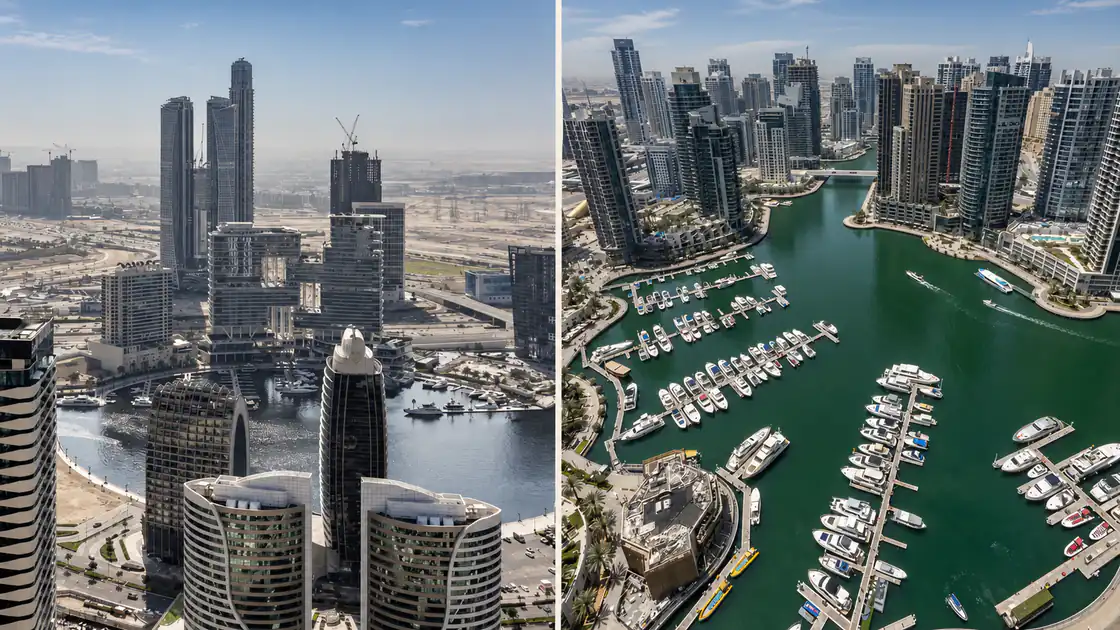
Business Bay vs Dubai Marina: Investor Comparison Guide
Compare Business Bay and Dubai Marina by use, tenant fit, transport, building evidence and operating constraints without relying on unverified price claims.